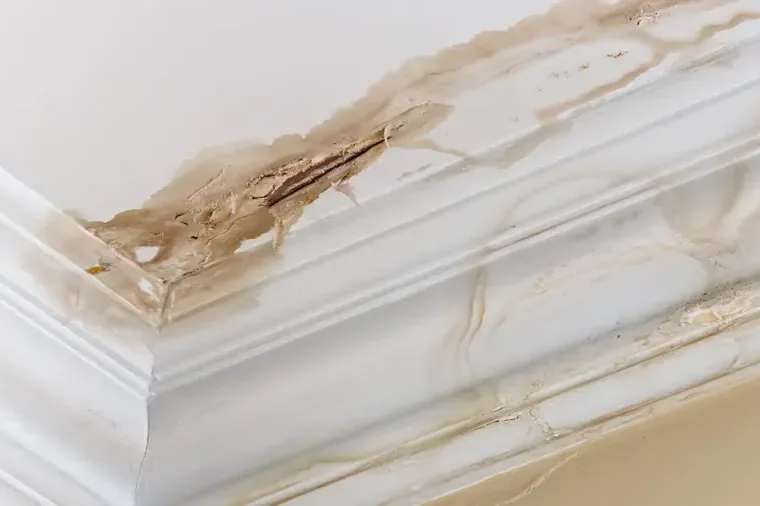


Can a sagging ceiling be dried instead of replaced?
Light staining can often be dried in place. A ceiling that sags, bulges or has been wet for a while usually has to be opened, because saturated drywall loses its strength.
In Ida, wet basement ceiling tiles fell in a local home, a reminder that soaked ceilings can drop without warning. Opening and drying a wet ceiling early protects both the room and the people under it.
(888) 471-9821Dry the wet ceiling
Move people and furniture out from under a bulging or sagging ceiling, since saturated drywall can drop suddenly.
Place a bucket under the stain, and if the ceiling bulges, a small hole at the lowest point drains it safely.
Shut off the water if a pipe above is leaking, and turn off power to any fixtures or outlets near the wet area.
Record the stain, the sagging area and anything damaged below, then call for extraction and drying of the ceiling cavity.
Ceiling leak cleanup ranges from $800 to $2,500 for one stain dried in place up to $6,000 to $14,000 or more for two units or a collapse. The size of the wet area and the water source decide the range.
For a planning number on your own loss, try the water damage cost calculator. Ranges are typical, not a quote: the water category, the square footage, the material class and how fast drying started move the final figure, which comes from the walkthrough and the moisture map.
Meters and thermal cameras show how far the moisture runs above the ceiling, and the source is traced to a pipe, roof or fixture.
Sagging or soaked sections are cut away in a controlled way so trapped water drains and the wet insulation can be reached.
Air movers and dehumidifiers, sometimes with a ducted system into the cavity, dry the framing and surrounding drywall to target.
The report lists the source, the sections removed and the readings, so the insurer and the repair contractor share the same facts.
A ceiling can look sound while holding a great deal of water. Soaked drywall gets heavy, loses strength and can come down in a single piece, which is why a stain deserves quick attention.
Water that reaches a ceiling has usually traveled through insulation and along joists first. By the time a stain shows, the cavity above is already wet, and the visible spot is only the part that soaked through.
A ceiling leak comes from somewhere above. A split pipe is covered under burst pipe water damage, and rain intrusion falls under roof leak water damage. Both can leave the ceiling in the same condition.
Stain-blocking paint hides a ceiling stain but does nothing about the water behind it. If insulation or drywall stays damp, the paint bubbles, the stain returns and the material weakens until it fails. Drying first and painting last is the only order that holds.
Plaster ceilings, drywall ceilings and suspended tiles behave differently when wet. Plaster is heavy and can crack or fall in sheets, drywall sags and softens, and tiles stain and drop individually. The crew adjusts the opening and the drying method to the material, so a simple tile replacement does not turn into a full demolition, and a plaster ceiling is not left to drip behind a fresh coat of paint.
Ceiling leak crews cover ZIP codes 07041 and 07078, from Short Hills houses to smaller in-town homes and condos near Millburn station, with ladders, meters and drying equipment on every truck.
The same service nearby: ceiling leak water damage in Orange, Irvington, Verona.
Light staining can often be dried in place. A ceiling that sags, bulges or has been wet for a while usually has to be opened, because saturated drywall loses its strength.
It can relieve trapped water, but keep clear of the area below and switch off power to nearby fixtures first. A crew can do it in a controlled way.
A dried surface can still hide wet insulation above it. Until the source is fixed and the cavity is dry, moisture keeps traveling to the same spot.
Yes. In one local home, wet basement ceiling tiles fell during Ida. Soaked ceilings of any type can drop without much warning.
They can if material stays wet long enough. Opening the ceiling and bringing readings to the dry target is what keeps the risk down.
The crew traces moisture to its origin and records it. A plumber or roofer then repairs the pipe, fixture or roof that caused it.
Printed ranges run from $800 to $2,500 for one stain dried in place to $6,000 to $14,000 or more for two units or a collapse.
One call sets up the opening, extraction and drying, and the crew explains what has to be cut away.