
Why does a frozen pipe leak only after it thaws?
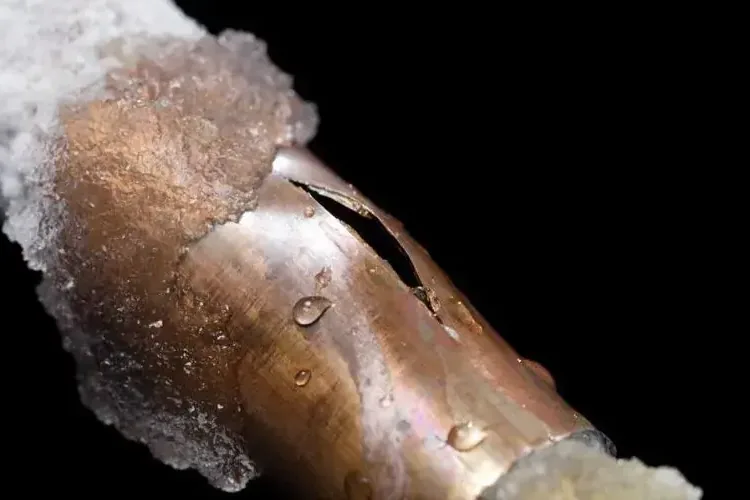
Ice blocks the split like a plug. When it melts, water flows through the crack under full pressure, and the flood starts.
A pipe that froze solid in a cold snap often splits quietly. The damage appears when the ice thaws and water pours into the wall or ceiling, and drying should start before that water settles in.
(888) 471-9821Report the thawed pipe leak
Close the main valve at once. Then open a faucet on the lowest floor to drain the pipes and relieve the pressure.
Leave the heat on and open cabinet doors under sinks so warm air reaches the pipes. Do not use a torch to thaw anything.
Take photos of the split section, wet walls and ceilings. Dates and times help the adjuster understand how long it ran.
Tell the crew which floor is wet. Hidden water inside wall cavities needs meters and a thermal camera to locate.
Frozen pipe damage usually runs $1,200 to $4,000 for one wall caught at the thaw and $4,000 to $9,000 when a ceiling below is wet. A long-running winter break in unheated space can reach $9,000 to $20,000 or more. Where the water traveled sets the final figure.
For a planning number on your own loss, try the water damage cost calculator. Ranges are typical, not a quote: the water category, the square footage, the material class and how fast drying started move the final figure, which comes from the walkthrough and the moisture map.
A thermal camera and moisture meter trace the wet path, which can run well beyond the room where the pipe actually split.
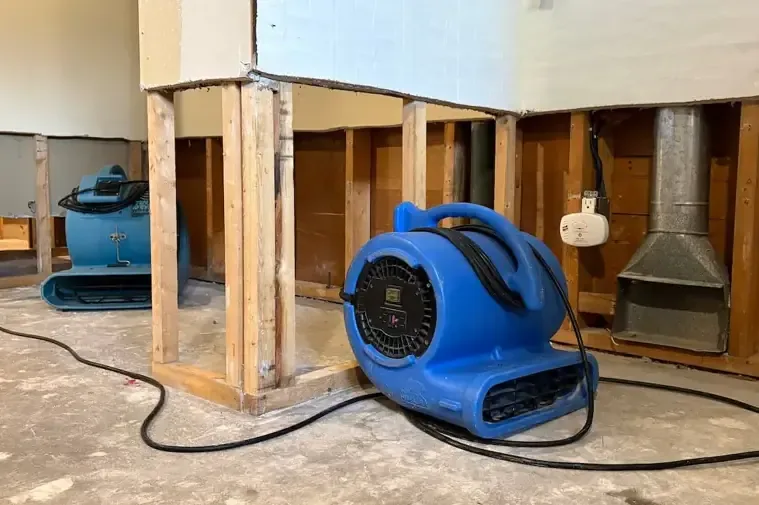
Soaked insulation and drywall are cut out in the smallest areas needed, and standing water is extracted from the floor.
Air movers, ducting and dehumidifiers dry the framing in place. Readings are taken daily until the studs reach the dry goal.
Final readings, photos and logs are bundled for the claim, and a plumber repairs the pipe before any rebuild begins.
Frozen pipes cause a particular kind of damage. The pipe splits while frozen, but the water only flows after the thaw, so the first sign is often a stain on a ceiling or a soft spot on a wall. Property owners often learn about it from a drip, a stain or a sudden loss of water pressure after a cold night.
As the ice melts, the split opens and clean supply water flows under full pressure. In a wall or ceiling, the water travels along framing and soaks insulation, which keeps it against the wood.
Pipes in attics, garages and exterior walls are the usual victims, since cold air reaches them first. A split can be only a few inches long and still release gallons once the thaw begins. A moisture meter finds the edge of the wet area, and a thermal camera shows where cooler, wetter material hides behind finished surfaces.
Clean water becomes less clean the longer it sits, and Category 1 can slip to Category 2 once it has soaked materials for a couple of days. The IICRC S500 window of 24 to 48 hours is the target for starting the dry-out. A plumber repairs the pipe, and the restoration crew handles everything the water touched. The two jobs are scheduled so drying is not interrupted.
Pipes that split without a freeze are covered under burst pipe water damage, and heating system leaks fall under radiator and boiler leaks.
Crews handle thaw leaks across ZIP 07003, including Brookdale, Watsessing, Ampere North and the streets near downtown and Bloomfield College, as well as homes around the Bloomfield Green Historic District and Silver Lake.
The same service nearby: frozen pipe water damage in Orange, Nutley, Verona.
Ice blocks the split like a plug. When it melts, water flows through the crack under full pressure, and the flood starts.
A hair dryer on low heat is safer. Torches and heat guns can damage framing and are never advised near a wall.
Usually not. Wet insulation holds water against the wood and is removed in the small area affected, then replaced after the framing dries.
Most jobs take several days of drying with daily readings. Larger losses spanning more than one wall or floor run longer.
A thermal camera narrows the opening to a small section. Only the wet material is cut, and the rest of the wall stays in place.
It starts as clean supply water, but long exposure to building materials can lower its category. Prompt extraction keeps the loss clean.
Sudden pipe bursts are commonly covered, though neglect clauses can apply to unheated space. The adjuster will want photos and drying logs.
Hidden water spreads quietly along framing and into floors below. One call brings meters, extraction and a drying plan.