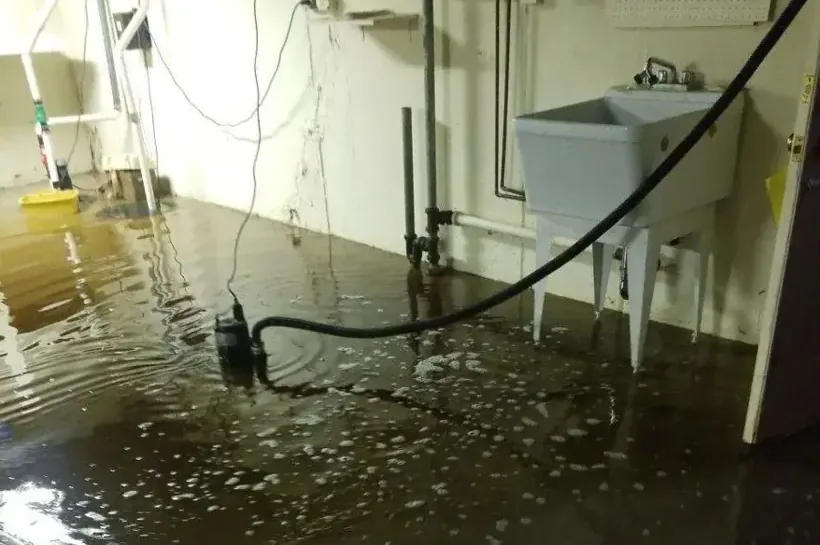


How deep does a basement flood get here?
It varies. One local basement flooded five feet in Ida, while a one-story home had waist-deep water with sewage in the basement. Depth and water source set the equipment and the safety steps.
One basement here flooded five feet deep in Ida and was taken down to the studs. Whether the water is a few inches or a few feet, the sequence is the same: pump, strip, dry, document.
(888) 471-9821Dry the flooded cellar
Do not enter a flooded basement until the breakers for it are off, because water around panels and outlets is a shock hazard.
Close the main valve for a pipe break, and move belongings from stairs and lower shelves to higher ground.
Take pictures of the water level on walls, stored items and the furnace or boiler before anything is moved.
Share the depth, the finish level and whether a sump pump is running or has failed, so the right equipment is loaded.
Basement flood cleanup runs from $1,500 to $4,000 for a shallow, unfinished cellar up to $9,000 to $25,000 or more for a finished basement with black water. Finish level and contamination drive the number most.
For a planning number on your own loss, try the water damage cost calculator. Ranges are typical, not a quote: the water category, the square footage, the material class and how fast drying started move the final figure, which comes from the walkthrough and the moisture map.
Submersible pumps remove the bulk of the water, then wands and wet vacuums clear what remains on the slab and low spots.
Soaked carpet, padding, insulation and the lower part of drywall are cut out and carried away, exposing studs and plates.
Dehumidifiers and air movers run on the slab, block walls and framing, and meters track each surface down to its target.
The furnace, boiler, water heater and panel are checked for water exposure and noted in the report for a qualified tradesperson to follow up.
Basement floods here come from several directions: a river over its walls, a storm drain backing up, or a sump pump that gave out. Hurricane Floyd in 1999 hit about 500 homes around the township.
Water in a basement does not stay on the floor. It wicks up block walls and drywall, soaks the bottom plate of every framed wall, and sinks into carpet and padding. Those hidden spots set the length of the job.
Anything removed is photographed first, so the insurance file shows what was lost and why it could not stay.
A bare cellar with a concrete floor may be pumped, rinsed and dried in a short job. A finished basement with carpet, drywall and a bathroom takes more demolition, which is why the price ranges climb steeply with finish level. Related work, such as structural drying and sump pump failure cleanup, often runs alongside.
After a storm like Ida, groundwater and runoff can carry silt, and sewage mixed in turns the job into sewage backup cleanup. Category 3 water is cleaned with protective gear and every porous material it touched is discarded.
Basement jobs cover ZIP codes 07041 and 07078, from Short Hills and Wyoming to Canoe Brook, Knollwood and the streets near Millburn Avenue, where the Rahway River has run high.
The same service nearby: basement flooding cleanup in Orange, Irvington, Verona.
It varies. One local basement flooded five feet in Ida, while a one-story home had waist-deep water with sewage in the basement. Depth and water source set the equipment and the safety steps.
Pumping begins once the power is off and the water source is controlled. Draining too late lets water soak into walls and framing, while a crew sets a safe pace and clears the slab.
Often the framing and slab can be dried and kept, while carpet, padding and drywall below the water mark are removed. Black water or long standing times push more material out.
Equipment sitting in floodwater is noted in the report. One local family replaced a hot water heater and two boilers after Ida, so an early look by the right trade matters.
That depends on the policy and the cause. Many policies treat river flooding, sewer backup and sump pump failure differently, so ask the insurer early and keep photos, readings and receipts.
Most basements take several days of drying, longer when finishes are deep or the water was. Readings are taken at each visit, and equipment leaves only when surfaces hit their dry targets.
Printed ranges start at $1,500 to $4,000 for a shallow unfinished cellar and reach $9,000 to $25,000 or more for a finished space with black water.
A single call lines up pumps, stripping and drying equipment, and the crew explains what is likely to be removed.