
Irvington is one of the most densely populated places in New Jersey. At 20,993.8 people per square mile in 2020, it ranked ninth highest of 565 municipalities. In a place built that closely, a leak on an upper floor rarely stays in one room. This post explains how an upstairs leak becomes a ceiling problem, what dries first and how a ceiling is opened safely.
Key takeaways
- A ceiling stain is a sign, not the source. The water usually started somewhere above it.
- A sagging ceiling holds water and can drop, so keep people out from under it and poke a small relief hole only if it is safe.
- Shut off the water supply to the suspected source, then extract and open the ceiling only as far as the readings require.
- Insulation and framing above the ceiling must be dried too, or the problem returns.
- A moisture meter, not the eye, shows when the ceiling and the cavity above are dry.
Why the density matters
The 2010 census counted 20,093 households and 23,196 housing units in Irvington, and the 2020 census density shows a very dense, closely built urban township. Buildings sit tight against each other, and rooms above rooms are common.
That means a bath, a kitchen or a washer on an upper floor can drop water onto the space below within a short stretch. The result is wet plaster or drywall, damp insulation and sometimes a neighbor's ceiling too.
Owners who share walls, floors or ceilings with neighbors have an extra reason to act fast. A slow leak that is ignored upstairs can become a shared problem with a neighbor, and that is harder to sort out than a single repair.
Where an upstairs leak starts
The stain on the ceiling is where the water came out, not where it started. Water travels along joists, pipes and wiring before it finds a low point.
- Supply pipes and fittings inside the floor above
- A bathtub or shower seal that has failed
- A toilet wax ring or supply connection
- A dishwasher or washer hose upstairs
- Roof or window leaks that run down an inside wall
What to do first
The first steps limit damage. They also protect people from a falling ceiling.
Do not use the lights or fans in a room with a wet ceiling until it is clear the wiring above is dry.
- Shut off the water to the suspected fixture, or the main valve if the source is unknown.
- Turn off power to the room if water is near fixtures, and stay clear of wet outlets.
- Move furniture and rugs out from under the stain.
- Place a bucket under any drip and a tarp over what cannot move.
- Photograph the ceiling, the wet walls and the floor before anything changes.
How a wet ceiling is opened safely
A sagging ceiling is heavy with water. The safest approach is to relieve the water in a controlled way, with a small opening at the lowest point and a container beneath.
The ceiling leak water damage page describes how a ceiling is traced, opened and dried. The point is to open only what readings show is wet, so repairs stay small.
What readings decide
A moisture meter and a thermal camera show how far the water spread above the ceiling. Dry sections stay in place.
Wet sections come out so the cavity can dry.
What gets removed
- Sagging or stained ceiling panels
- Wet insulation above the ceiling
- Drywall or plaster that has lost strength
- Wall sections where water ran down the inside
Drying the room below and the space above
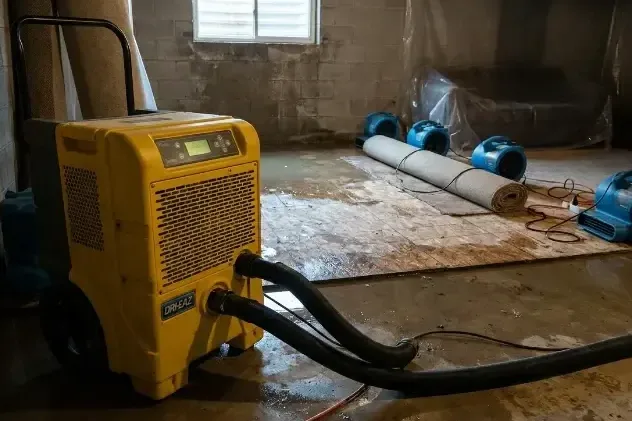
Once the wet material is out, the focus moves to extraction and drying. Water on the floor below is removed first, as described on the water extraction page, because a wet floor puts moisture back into the room.
Air movers and dehumidifiers then run while a crew logs readings. The goal is to dry the ceiling cavity, the framing and the walls, not only the visible surface.
In a closely built building, it is also wise to check the neighbors. A wall shared with the next unit can carry water too, so a short conversation or a notice to the manager can save a second claim.
Preventing the next upstairs leak
Prevention is mostly about attention to upstairs fixtures.
- Replace old washer hoses and check supply connections once a year.
- Re-caulk tubs and showers when sealant cracks.
- Learn where each valve is so a leak can be stopped fast.
- Check the ceiling below any bath after a long shower for new stains.
- Report slow drips early instead of waiting for a stain to spread.
Plaster, drywall and what each does when wet
Ceilings are made of different materials, and each reacts to water in its own way. Drywall softens and sags.
Plaster can hold water for a long time, then crack or let go in a sheet.
A painted stain may look small while the material behind it is soaked. That is why a meter reading beats a visual check.
Insulation above a ceiling acts like a sponge. Once it is wet, it keeps water against the ceiling and slows drying, so wet insulation is removed rather than dried in place.
- Drywall: soft or sagging sections are cut out.
- Plaster: checked with a meter and removed where it is loose.
- Insulation: wet batts are bagged and replaced.
- Framing: dried in place and re-checked with readings.
Telling the building manager and neighbors
In a closely built township, the cause of a leak is sometimes in another unit or on another floor. A quick note to the building manager and the neighbors above and beside the leak helps find the source sooner.
Photographs and a written timeline are useful here too. They show when the water appeared and what was done about it.
Where Springfield Avenue businesses fit
Springfield Avenue is the main commercial district, and upper floors above shops share the same risk. A leak upstairs can reach a shop below and interrupt business.
The main city ceiling page explains how the same steps apply across the area.
Questions
Why is Irvington so exposed to ceiling leaks?
The township is dense and closely built, with a 2020 density of 20,993.8 people per square mile. In tightly built places, rooms above rooms are common and one leak can reach several spaces.
Should a bulging ceiling be popped?
Only if it is safe and the water has nowhere else to go. A small relief hole at the lowest point with a bucket underneath lets the water out in a controlled way.
What is the first thing to do?
Shut off the water to the suspected fixture or the main valve, keep people out from under the ceiling and photograph the damage.
How is the ceiling confirmed dry?
A moisture meter shows readings in the ceiling and the cavity above. Equipment stays until those readings match dry reference points.
Will insurance cover ceiling damage?
That depends on the policy. Photographs, a timeline and receipts for dry down help whichever way it goes.